Service Dog Tasks and the Public Access Test, Explained
This page explains the law in general terms. It is not legal advice. For a specific situation, contact the agency listed on this site or an attorney.
Two ideas come up again and again when people plan to train a service dog in Nebraska: the tasks the dog performs, and the public access test. They are related, but they are not the same thing, and neither one is a license or a certificate.
This guide walks through how to define your dog's tasks, how to train them, and how to use a public access test as a practice goal. It also covers where the law starts and stops.
The short version
- Under the ADA, a service animal is a dog that has been individually trained to do work or perform tasks for an individual with a disability (ADA.gov Service Animals FAQ).
- The task must be directly related to the person's disability.
- Comfort, companionship and emotional support alone do not count as a task under the ADA.
- A public access test is a training benchmark, not a legal requirement under the ADA.
- There is no official service dog registry or required certification under the ADA.
What counts as a task under the ADA
The ADA.gov Service Animals FAQ says the dog must be individually trained to do work or perform tasks for a person with a disability. The work or task must be directly related to the person's disability.
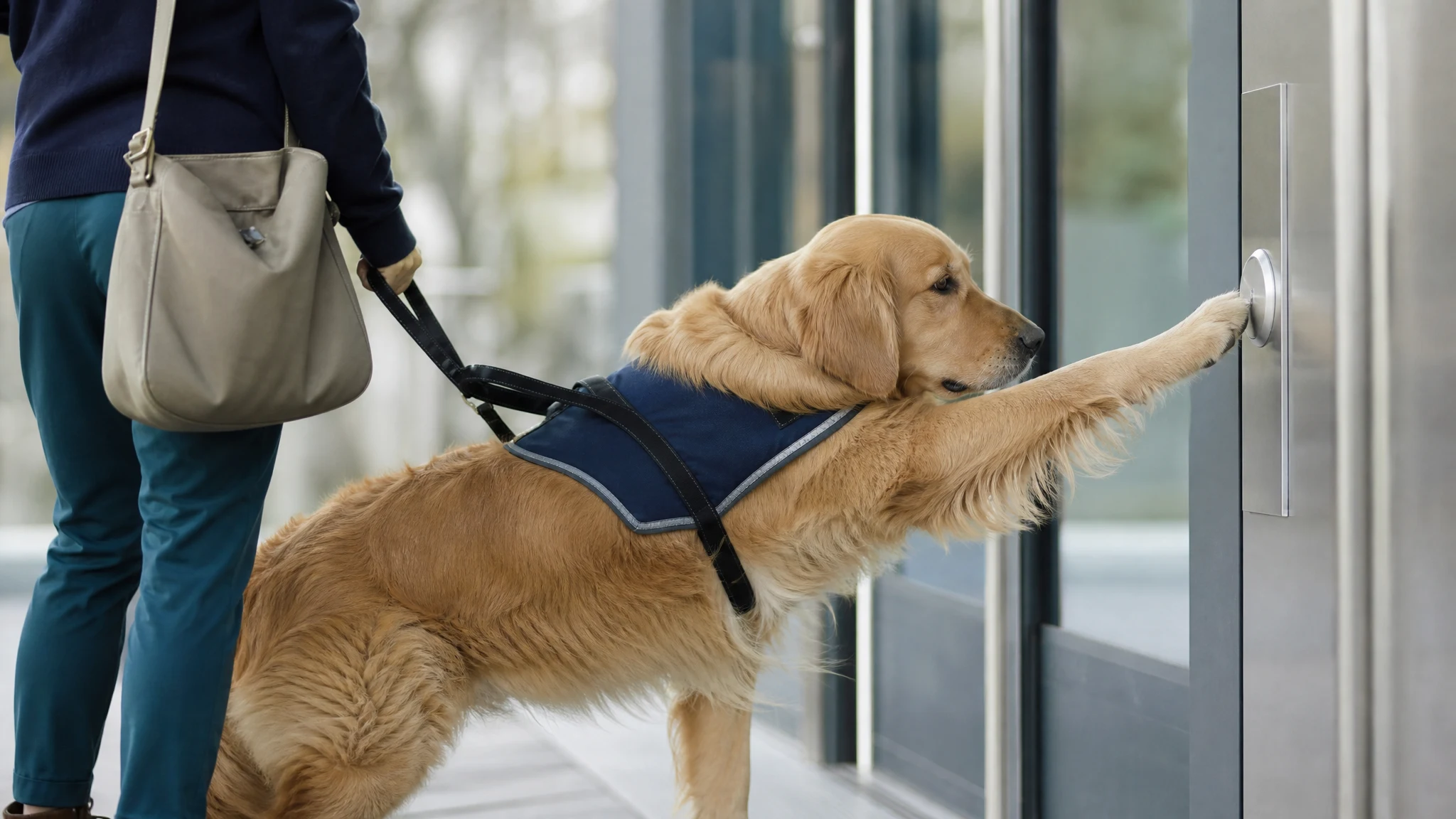
A useful test is this: could the dog do something specific, on cue or in response to a trigger, that lessens the effect of the disability? If the answer is yes, you are probably describing a task. If the dog helps simply by being present, that is not a task.
Examples of tasks by type of disability
The ADA.gov FAQ gives examples of the kind of work service dogs do. The list below follows those examples and groups them by disability. It is not a complete list.
| Type of disability | Example tasks |
|---|---|
| Vision loss | Guiding a person who is blind or has low vision around obstacles |
| Hearing loss | Alerting a person who is deaf or hard of hearing to a sound, such as a knock or an alarm |
| Mobility disability | Pulling a wheelchair, retrieving dropped items, bracing for balance |
| Seizure disorder | Alerting to an oncoming seizure or responding during one, as the dog is trained to do |
| Diabetes or other medical conditions | Alerting to a change the dog is trained to notice, or reminding the person to take medication |
| Psychiatric disability, such as PTSD | Interrupting a harmful behavior, turning on lights, or performing a trained action to calm the person during an anxiety episode |
That answers the common question of what tasks a service dog can do: any trained action that directly relates to the handler's disability. The list is open ended, which is why your own plan matters more than any checklist.
Why comfort alone is not a task
Many dogs make their owners feel better. That is valuable, but the ADA draws a line. Emotional support, therapy and comfort animals are not service animals under the ADA, because providing comfort by being there is not trained work or a trained task.
The line can feel thin with psychiatric disabilities. A dog that is trained to recognize a panic episode and then press on the handler's legs on cue is performing a task. A dog that is simply calming to be around is not. What matters is the individual training, not the dog's temperament.
If a dog does not meet the ADA definition, other rules may still apply in some settings, such as housing. Check with the agency in the Sources list for your situation.
The public access test is a benchmark, not a legal requirement
Assistance Dogs International (ADI) is an accreditation body for assistance dog programs. Its public access test is a standard that programs use to judge whether a dog behaves reliably in public places. Many handlers who train their own dogs use the same idea as a practice target.
The ADA does not require a service dog to pass this test, or any test. The ADA also does not require a certificate, vest, ID card or registration. A paper or online registration is not legal proof that a dog is a service animal.
The ADA does expect the dog to be under the handler's control and housebroken. The public access test is one practical way to build toward that.
For the exact current test items and scoring, check with ADI directly. Do not rely on a third-party summary.
What you need
- A dog that is healthy and temperamentally suited to public work. Check with your own veterinarian about health and fitness for the work.
- A written list of your disability-related needs and the tasks that might help.
- A flat buckle collar or a well-fitted harness and a standard leash.
- Small, soft treats your dog loves, plus a treat pouch.
- A clicker or a marker word, if you use one.
- A training log, either a notebook or a phone note.
- A helper or two for distractions, such as a friend with a cart or a second dog.
- Access to quiet places first, then busier ones, so you can build up in steps.
Step by step: building tasks, then testing in public
Step 1: Define the task in plain words
Write one sentence for each task: the trigger, the dog's action, and how it helps. For example: "When I drop an item, the dog picks it up and puts it in my hand." A clear sentence keeps training consistent and shows you that the task is tied to the disability.
Step 2: Teach the building blocks first
Most tasks are chains of simple behaviors, such as touch, pick up, hold, carry, settle and paws up. Teach each piece separately with rewards. Reward-based methods, in line with the American Veterinary Society of Animal Behavior (AVSAB), help dogs learn without fear and keep them willing to work.
Do not use shock, prong or choke collars, alpha rolls, scruffing or any dominance method. They add stress to a dog who will need to stay calm in public for years.
Step 3: Chain the pieces into the full task
Once each piece is solid, link them. Add the trigger last. For an alert task, you might first teach a nose touch, then pair it with a scent or sound the dog learns to notice, then reward only when the dog does the alert on its own.
Keep sessions short, often five to ten minutes. Stop while the dog is still keen.
Step 4: Proof the task in new places
A task done well at home may fall apart in a parking lot. Practice in a new room, then the yard, then a quiet store at off-peak hours. Raise one difficulty at a time: location, distraction, duration or distance.
Step 5: Build public manners
Work on the habits a public access test looks at. Typical areas include:
- Walking calmly on a loose leash past people and carts
- Settling on the floor under a table or chair
- Ignoring dropped food and other dogs
- Staying calm around unexpected noises
- Entering and exiting doors and vehicles politely
- Staying relaxed when strangers talk to you
- Toileting on cue, so accidents are unlikely
Treat that as a general list for practice, not as the official test.
Step 6: Run a mock test with a helper
Ask a friend to play the part of a store crowd or a distracting passerby. Write down what happened, not just whether it passed. Note where your dog hesitated, sniffed, pulled or looked to you for help.
Step 7: Repeat until it is boring
The goal is dull, steady behavior. If the dog is excited, stressed or checking out, go back a step. If the dog repeatedly shows fear or distress in public, that is information. Some dogs are not suited to this work, and choosing a different path for that dog is a responsible choice.
Step 8: Take the official test if you want one
If your goal is a formal evaluation, contact an ADI-accredited program or a trainer who administers the test, and ask what the current requirements and fees are. Do not assume a price or a schedule. Programs set their own.
Tips
- Train for the real day. Practice at the times and in the places you will actually use the dog.
- Watch your dog's stress signals. Lip licking, yawning, a tucked tail or a stiff body mean you pushed too far.
- Keep a log. A record of dates, places and results shows progress and helps you spot patterns.
- Plan for breaks. Even good service dogs need downtime and play.
- Tell the truth about the dog's training. If someone asks, you can describe the task honestly.
Common mistakes to avoid
- Calling comfort a task. If the dog does not do trained work, the ADA does not treat it as a service animal.
- Buying a registration, certificate or ID. The ADA does not require them, and they do not prove anything legally.
- Skipping the basics. A flashy task on top of weak settle and leash manners will not hold up in public.
- Moving too fast. Jumping from the living room to a crowded store invites failure.
- Using harsh corrections. They can damage trust and make public behavior less reliable.
- Treating the test as the law. Passing a public access test does not create legal rights, and failing one does not remove them.
What to expect
With regular, patient reward-based practice, many dogs can learn reliable tasks and calmer public behavior. Timelines vary a great deal with the dog's age, temperament, the complexity of the task and how often you train. Some tasks may take months, and some dogs may not end up suited to the work.
A mock public access test can help you see where your dog is strong and where it needs more work. It does not guarantee a pass, or a result in any particular setting.
What the ADA lets staff ask
When it is not obvious what a dog does, ADA.gov says staff may ask two questions: (1) Is the dog a service animal required because of a disability? (2) What work or task has the dog been trained to perform? Having your task sentence from Step 1 ready makes the second question easy to answer.
Nebraska law at a glance
Nebraska law adds its own protections. Here is what the statutes say, with the citation, and where to check further.
- Definition. Neb. Rev. Stat. 49-801 defines service animal by reference to the federal ADA regulation 28 C.F.R. 36.104 as it existed on January 1, 2008.
- Public places. Under Neb. Rev. Stat. 20-127(3), a person with a disability has the right to be accompanied by a specially trained service animal in the places the section lists, with no extra charge for the animal. The person is liable for damage the animal causes. Section 20-132 separately guarantees full and equal enjoyment of places of public accommodation.
- Trainers. Section 20-127(2) allows a bona fide trainer of a service animal to be accompanied by the animal in training in the listed places, without an extra charge. Read the full statute text for any conditions before you rely on this.
- Housing. Under Neb. Rev. Stat. 20-131.04, a person with a disability who has or obtains a service animal has full and equal access to housing accommodations with the animal. The person may not be charged extra compensation for it, and is liable for damage the animal does to the premises.
- Employment. Neb. Rev. Stat. 48-1104 makes it an unlawful employment practice to refuse to hire, discharge or harass someone because of disability. I did not find a service-animal-specific employment provision in it, so ask the agency below about your situation.
- Interference. Neb. Rev. Stat. 28-1009.01 covers violence on or interference with a service animal.
For penalties for misrepresenting a pet as a service animal, or for any state ID program, check with the Nebraska Legislature and the agency below. This article does not state one.
This is a plain-language summary, not legal advice. For a broader look at training routes, programs and costs in the state, see service dog training in Nebraska: laws, programs and costs.
If you believe your rights were denied
The Nebraska Equal Opportunity Commission (NEOC) handles employment, housing and public accommodation matters. Its main office is at 1526 K Street, Suite 310, Lincoln, NE 68508, with offices also in Omaha and Scottsbluff. Visit its website for current steps and filing details.